If Greenwich Village feels different from almost everywhere else in Manhattan, you are not imagining it. Some of its most memorable spaces are not the famous avenues or postcard corners, but the tucked-away mews, gated courts, bent streets, and leftover lots that make the neighborhood feel layered and personal. If you are trying to understand what gives the Village its appeal, and what that can mean if you hope to live there, this guide will walk you through the hidden corners that define it. Let’s dive in.
Why Greenwich Village Feels So Distinct
Greenwich Village Historic District was designated on April 29, 1969, and the Landmarks Preservation Commission describes it as one of its earliest designations and still the largest historic district in New York City today. In the Commission’s own framing, the neighborhood stands out for its range of building types, diverse history, and the sense of hidden charm created by small streets, service lanes, and irregular spaces that interrupt Manhattan’s grid. You can explore that background in the LPC’s Greenwich Village historic district story map.
What makes the Village feel storybook is not one landmark block. It is the way grander edges like Fifth Avenue, Washington Square North, and West 8th Street give way to quieter secondary spaces behind them or beside them. According to the district designation report, the neighborhood’s character comes in part from rear yards, stable lanes, altered service buildings, and streets that bend instead of running straight.
That history still shapes how you experience the area today. In Greenwich Village, charm often comes from spaces that were never meant to be formal showpieces in the first place.
Washington Mews and Alley Streets
Washington Mews Shows the Pattern
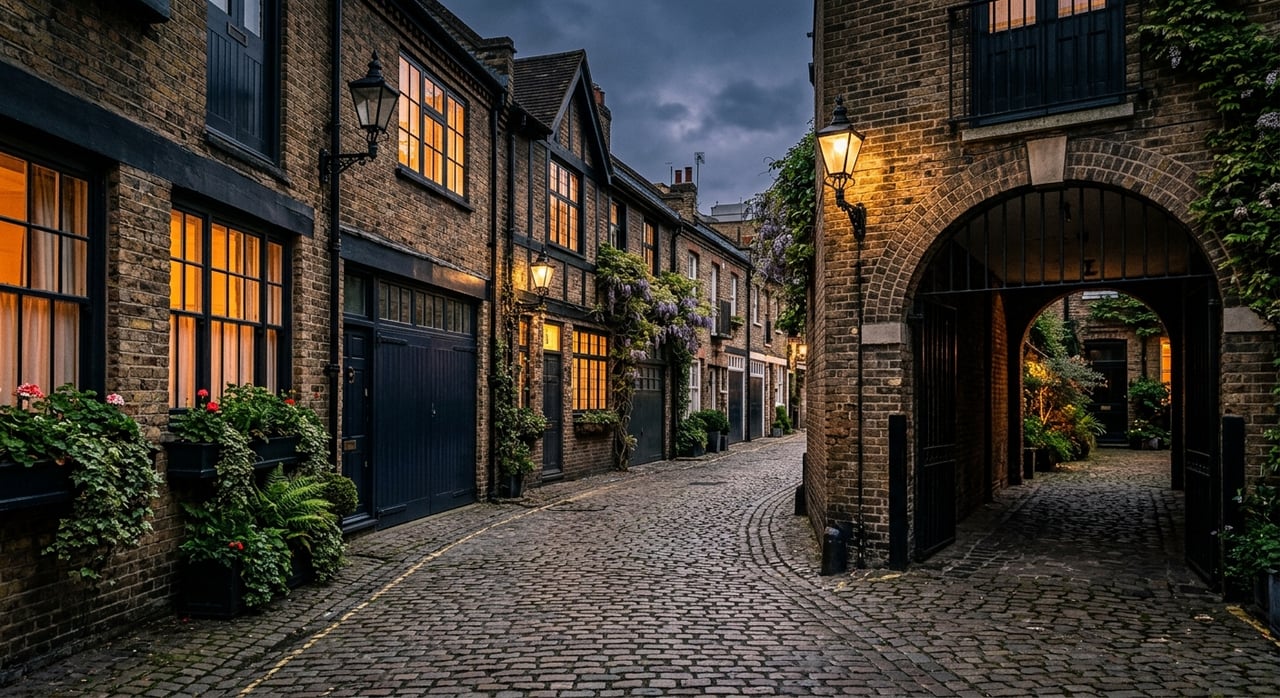
Few places explain the Village better than Washington Mews. The designation report describes it as a narrow, cobbled, private street between Fifth Avenue and University Place, lined with low two-story houses that create the feeling of a small urban village with unusual light, air, and protection from traffic.
Its name reflects its original use as a stable lane, and many of its buildings were once stables. The report also notes that the street was leased to New York University by Sailors’ Snug Harbor in 1949. That backstory matters because it captures a larger Greenwich Village theme: utilitarian service spaces were often adapted into homes, studios, and small residential buildings rather than cleared away.
MacDougal Alley Keeps Its Past Visible
MacDougal Alley offers another version of that same transformation. The designation report describes it as a former service space where stable buildings later became studios, dwellings, and restaurant use, with carriage openings still visible on some facades.
That visible layering is part of what makes the Village feel authentic rather than manufactured. Instead of a neighborhood built all at once, you are looking at a place that evolved in pieces, where older forms were reused and absorbed into daily life.
Why Mews Feel Different
In Greenwich Village, a mews is usually not a grand residential boulevard. It is more often a low-scale, historically practical corridor that later softened into housing, artist studios, or compact apartments.
For buyers, that often signals a very specific kind of property experience. You may find intimacy, historic detail, and a tucked-away setting, but not the scale or layout you would expect in a newer downtown building.
Courtyards and Gated Enclaves
Patchin Place Feels Cinematic
Patchin Place is one of the most enclosed pockets in the neighborhood. The designation report describes ten three-story brick houses built in 1848 for Aaron D. Patchin, arranged along a short dead-end street with an iron gate and a strong sense of seclusion.
Part of its appeal comes from the compression of the space. You move from a busy urban setting into a small enclosed row that feels suddenly removed from the city around it, even though you are still in the middle of it.
Milligan Place Hides Off Sixth Avenue
Milligan Place is smaller, but it shows how powerful scale can be in Greenwich Village. The Landmarks Preservation Commission describes it as a little courtyard with four houses on its south side, built in 1852, with a narrow entrance that cuts it off from the noise of Sixth Avenue.
That contrast is one of the neighborhood’s defining pleasures. A thin opening can lead to an entirely different atmosphere, which is why these spaces tend to stay so memorable.
Grove Court Is a Rear-Yard Retreat
Grove Court is one of the Village’s best-known hidden enclaves. Village Preservation describes Grove Court as a group of tiny houses behind a private gate and triangular courtyard, built in 1852 to 1854 as workingmen’s cottages on the rear yards of earlier Grove Street houses.
The same source notes that the homes are small by modern standards. That detail matters if you are house hunting in the area, because part of the appeal of these historic pockets is also the tradeoff: they often offer rarity and atmosphere rather than generous square footage.
Crooked Streets and Leftover Lots
Gay Street Bends Beautifully
The Village’s charm is not limited to enclosed courts. Sometimes it comes from a simple bend in the street. The designation report calls Gay Street exceptionally charming and well preserved, with Federal houses on one side, Greek Revival houses on the other, and a non-rectilinear streetscape that feels very different from Manhattan’s usual rhythm.
That irregularity changes how the block unfolds as you walk it. The view does not reveal itself all at once, which gives the street a softer and more intimate feel.
Commerce Street Rewards Looking Closely
The pair at 39 and 41 Commerce Street is a strong example of what you might call Greenwich Village leftover-space magic. Village Preservation explains that these Federal houses were built in 1831 and 1832, that the garden between them remained unbuilt, and that the bend in Commerce Street helps create their distinctive setting.
Their mansard roofs, added in the 1870s, add to the picturesque effect. It is a reminder that in the Village, some of the most memorable visual moments come from what was not built as much as what was.
75 1/2 Bedford Tells a Village Story
Few addresses capture the neighborhood’s unusual scale better than 75 1/2 Bedford Street. Village Preservation identifies it as the narrowest house in Greenwich Village, dating to 1873.
The designation-era report also points to this stretch of Bedford Street as an extreme example of the district’s unusually small-scale houses. For buyers, that is a useful reality check. In this part of Manhattan, uniqueness often comes from dimensions and layouts that differ sharply from modern expectations.
What Hidden Corners Mean for Buyers
These streets and courts are beautiful, but they are also helpful clues about the local housing stock. The research points to a neighborhood shaped by low-rise rowhouses, compact courtyard homes, former stables, studios, and occasional small apartment buildings rather than large modern towers.
If you are searching in Greenwich Village, you are often not comparing one standard apartment format to another. You may be choosing between a gated court, a converted stable, a crooked historic row, or a compact house on an unusual lot.
That can be exciting, but it also calls for careful evaluation. Layout, light, access, privacy, and renovation constraints can vary widely from one block to the next, even when properties sit only a short walk apart.
Why Landmark Rules Matter
In a neighborhood like this, preservation is part of the living experience. According to the NYC Landmarks Preservation Commission permit guidance, most exterior changes to buildings in historic districts require review, including work on front and rear facades and even some projects that are not visible from the street.
That means the Village’s scale and visual continuity are not just the result of taste or luck. In many cases, they are reinforced by active landmark regulation.
For a buyer or owner, that can be both reassuring and practical. The same framework that helps protect the look of these hidden corners can also shape timelines, approvals, and the scope of future exterior work.
How to Read the Village Like a Buyer
If you are exploring Greenwich Village with a real estate lens, it helps to look beyond the headline address. A prominent avenue may carry the cachet, but the property’s actual character may come from what sits behind it, beside it, or just off the main path.
A useful way to think about the neighborhood is in layers:
- Major streets set the broader location and access
- Smaller side streets often shape the immediate feel
- Mews and courts can create a more secluded setting
- Historic building form often affects layout and scale
- Landmark rules may influence future changes
That layered approach is especially important downtown, where two homes with similar addresses can offer completely different living experiences.
The Village’s Real Appeal
What makes Greenwich Village so compelling is not perfection or uniformity. It is the fact that the neighborhood still reveals traces of old service lanes, rear-yard cottages, crooked streets, and small brick rows that were adapted over time instead of erased.
That is why the area feels so different from places built around larger towers or stricter grids. Its charm comes from historic intimacy, visual surprise, and the sense that every block has its own logic.
If you are considering a purchase, sale, or rental in Greenwich Village or elsewhere downtown, working with a team that understands how block-by-block differences affect value and daily life can make the search much more efficient. To talk through the hidden character of a property, its building context, or your next move below 34th Street, connect with The Johnny Lal Team.
FAQs
What is a mews in Greenwich Village?
- In Greenwich Village, a mews is typically a narrow former service lane or stable street that was later adapted into low-scale residential buildings, studios, or small apartments.
Why do Greenwich Village streets feel different from the Manhattan grid?
- The neighborhood includes bent streets, leftover lots, rear-yard development, and former service spaces that interrupt the formal grid and create a more layered streetscape.
Are hidden courtyards in Greenwich Village public streets?
- Some are visible from public areas, but several well-known enclaves are gated, private, or visually separated from surrounding traffic.
How do historic district rules affect Greenwich Village homes?
- In the Greenwich Village Historic District, many exterior changes require review by the Landmarks Preservation Commission, including some work on rear facades and projects not visible from the street.
What housing types are common in Greenwich Village hidden corners?
- These areas often feature low-rise rowhouses, compact courtyard houses, converted stables, artist studios, and small apartment buildings rather than large modern towers.
Why should buyers look beyond a Greenwich Village address?
- In Greenwich Village, a property’s daily experience can depend heavily on its exact street, court, or alley setting, along with building form, privacy, light, and landmark constraints.